
The False Choice
A common question we hear from business owners is whether they should abandon traditional SEO and focus entirely on AI SEO. The short answer is no. Treating them as entirely separate disciplines is a mistake that will ultimately harm your visibility across all platforms. To understand how different platforms like ChatGPT and Gemini handle these signals, read our comparison of AI platforms.
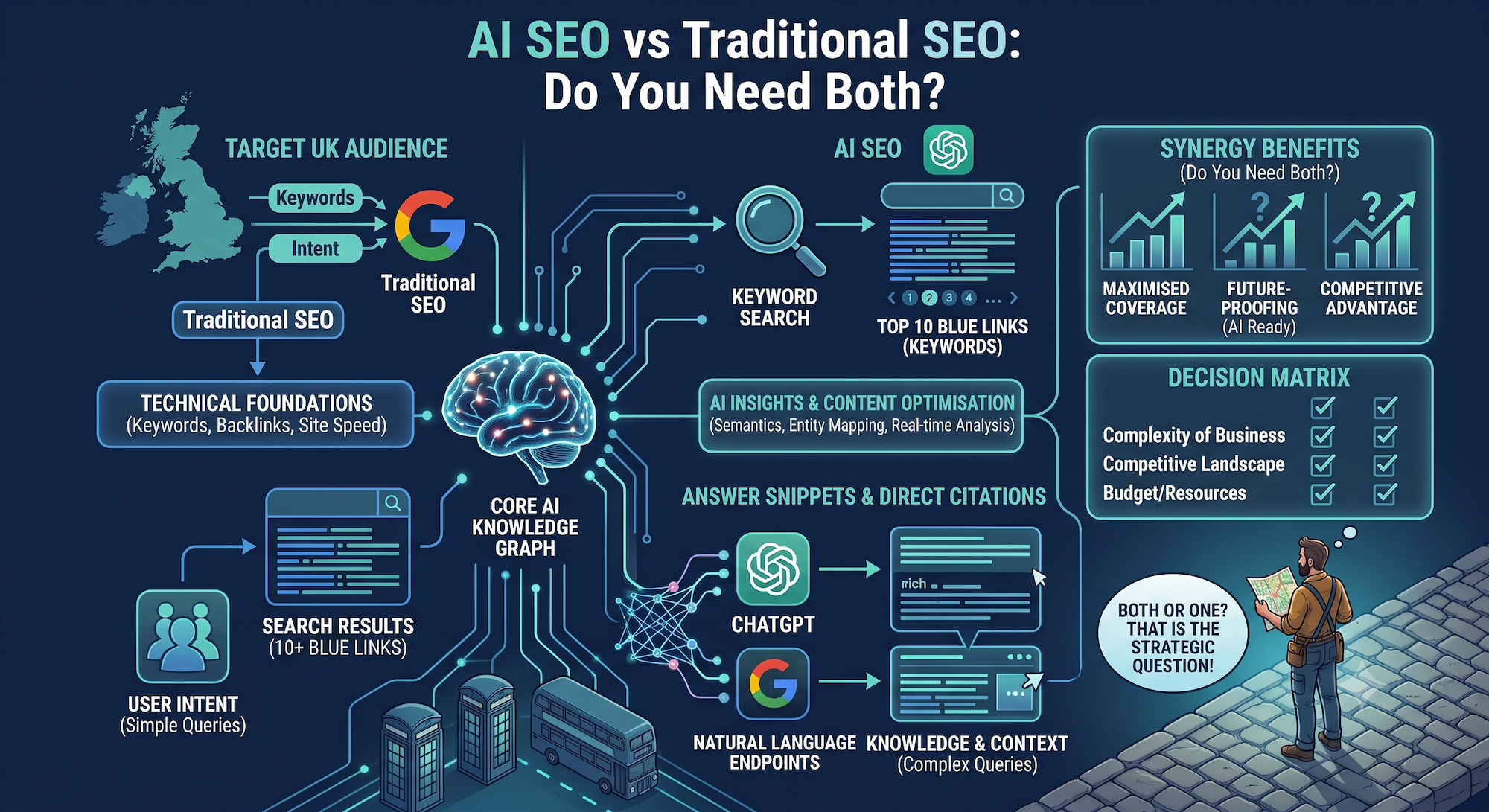
AI SEO and traditional SEO are not competing strategies. They are two sides of the same coin. Strong AI SEO is built on strong traditional SEO foundations, and the techniques used to optimise for AI often yield significant benefits for your Google rankings. If you want to understand the full picture, our What Is AI SEO guide covers the basics in plain English.
The Foundations Remain the Same
Consider how AI platforms like ChatGPT, Perplexity, and Copilot actually work when they browse the web. They rely on search engine indexes, primarily Bing and Google, to find the information they need to generate an answer. If your website is not indexed, if it is too slow to crawl, or if it lacks basic technical SEO hygiene, the AI will never find it.
Traditional technical SEO, ensuring your site is fast, mobile friendly, secure, and easily crawlable, is the absolute prerequisite for AI visibility. You cannot optimise for Answer Engines if the engines cannot read your site in the first place.
Where the Strategies Diverge
While the technical foundations are shared, the content strategies for traditional SEO and AI SEO begin to diverge when we look at the end goal.
Traditional SEO often focuses on keyword density, long form content designed to keep users on the page, and acquiring as many backlinks as possible. The goal is to rank in the top ten blue links.
AI SEO focuses on entity definition, clear question and answer formatting, and structured data. The goal is to be the single, definitive answer that the AI extracts and presents to the user.
The Danger of Having One Without the Other
What happens if you focus purely on traditional SEO? You might rank well on Google for specific keywords. But when a user asks ChatGPT to recommend a service provider in your sector, the AI might bypass your keyword stuffed articles in favour of a competitor whose content is structured as clear, direct answers.
Conversely, what happens if you focus purely on AI SEO, ignoring traditional ranking factors? You might have perfectly structured FAQ schema and clear entity definitions, but if your site lacks authoritative backlinks and technical performance, the AI crawlers may not trust your site enough to cite it.
The Synergy of a Combined Approach
The most successful businesses are those that integrate both approaches. When you restructure your content to clearly answer specific questions for AI systems, you also improve the user experience, which is a strong positive signal for Google.
When you implement comprehensive schema markup to help AI understand your business, you also increase your chances of securing rich snippets in traditional Google search results.
AI SEO does not replace traditional SEO. It builds upon it, adding a layer of structural clarity and directness that is essential for the future of search. Businesses that recognise this synergy will dominate both the traditional results pages and the new wave of AI generated answers.
Find Out Where You Currently Stand
Our free AI SEO audit shows you exactly how visible your business is across ChatGPT, Gemini, Perplexity, Grok and Google AI Overviews today.
Get Your Free AI SEO Audit