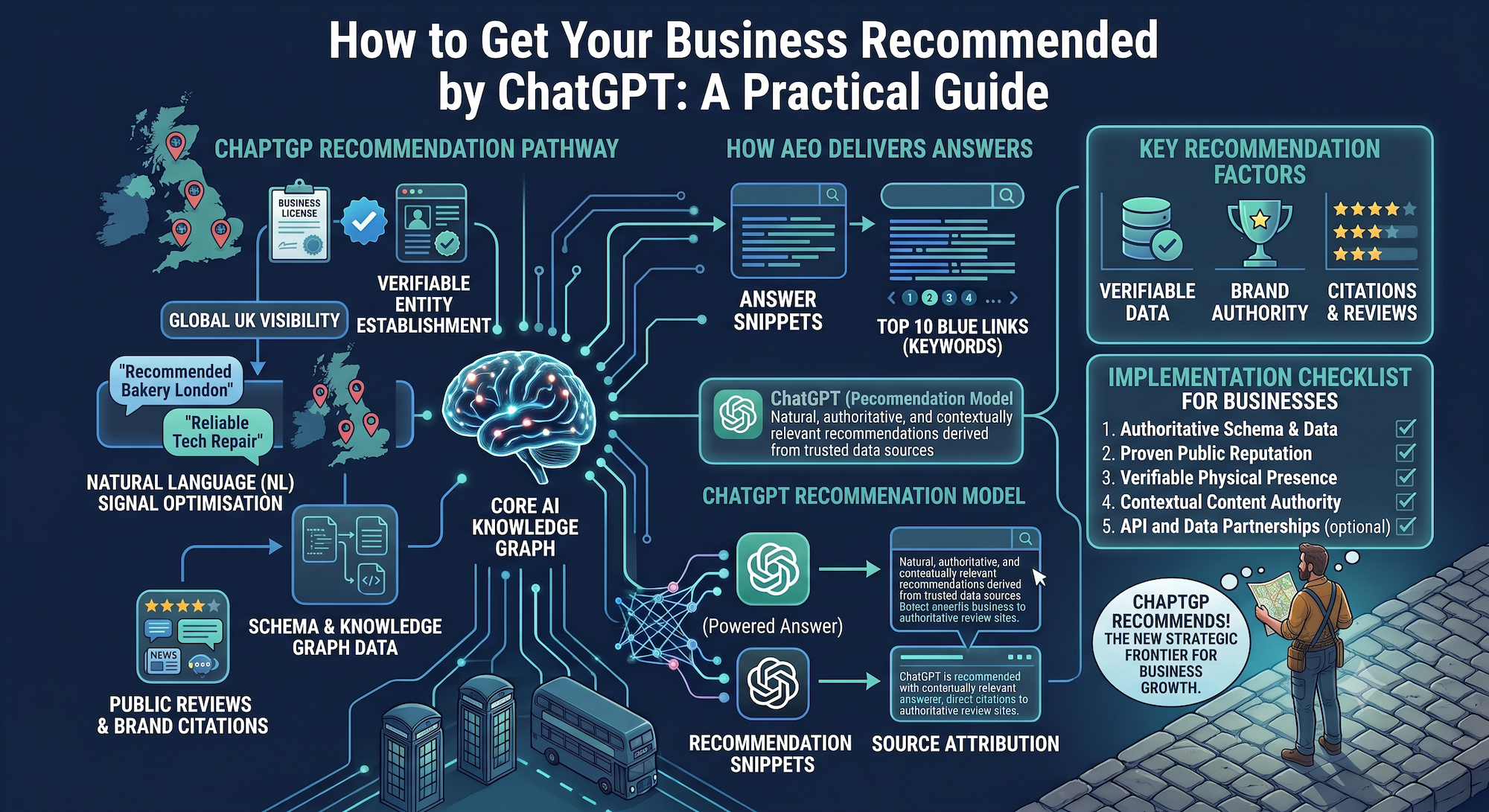

How AI Actually Picks Winners
Right, let's get one thing absolutely clear from the start: getting ChatGPT to mention your business isn't about gaming some highly secretive algorithm. It is, frankly, just about feeding the system exactly what it wants: clear, structured facts it can actually trust. When someone asks an AI for a recommendation, the machine rummages through its training data and live web results looking for the most credible match. Your job is simply to make sure your business is the most obvious, reliable answer in the room.
I've put together the exact technical steps we use to get our clients visible on ChatGPT and other AI platforms. If you want a snapshot of where you currently stand before diving in, grab our free AI SEO audit.
Step 1: Stop Being Vague (Define Your Entity)
AI does not read your website like a human being does. It maps the world using "entities"—which is a fancy way of saying distinct concepts, places, or businesses. If ChatGPT can't quickly figure out exactly who you are, what you sell, and where on earth you're based, it simply won't risk recommending you. It's not stupid.
What you need to do:
First, strip the marketing waffle off your homepage. Stop saying things like "We deliver paradigm-shifting synergy solutions." It's complete rubbish. Just say, "We are a commercial accounting firm based in London." The AI needs plain English.
Second, get your business listed on major knowledge bases. AI models scrape data from places like Wikipedia, Wikidata, Crunchbase, and big industry directories. Make sure your details match up perfectly across all of them.
Step 2: Speak the Machine's Language (Schema)
Schema markup is essentially a piece of code that spoon-feeds context to search engines and AI. Instead of making the crawler guess what a block of text means, schema explicitly tells it.
What you need to do:
Get Organization schema on your homepage immediately. It should clearly list your legal name, logo, contact info, social links, and a brief summary of what you actually do.
If you serve a specific area, add LocalBusiness schema to define your exact service radius, physical address, and opening hours.
Finally, use FAQPage schema. This is absolutely massive. It formats your frequently asked questions so AI systems can instantly grab them and use them as direct answers.
Step 3: Answer Questions Directly
Old-school SEO trained us to write massive, sprawling articles just to stuff in keywords. AI SEO is the exact opposite. These systems want sharp, direct answers to very specific questions. They don't have time for your life story. If you're a local business, the approach is slightly different—check out our guide to local AI SEO.
What you need to do:
Look at the content you already have. Find the pages where you answer customer questions, and rewrite the subheadings to match exactly how a real person would ask the question.
Right beneath that heading, drop a clear, one-paragraph answer. You can go into more detail further down the page if you must, but give the AI the quick summary it needs right at the top.
Step 4: Prove You're the Real Deal
ChatGPT decides if you're trustworthy by checking who else is talking about you. You can claim to be the best plumber in Manchester all day long, but if no other reputable website agrees, the AI won't back you up. It'll just ignore you.
What you need to do:
Start focusing on digital PR. Getting mentioned on a trusted news site or a respected industry blog is a massive trust signal for AI.
You also need real customer reviews. AI models constantly pull from Trustpilot, Google Business Profile, and niche review sites when deciding who to recommend. Get a system in place to collect these regularly, for heaven's sake.
Step 5: Watch What Happens
AI models change constantly. What works today might shift next month, so you can't just set this up and wander off to the pub.
What you need to do:
Make a habit of testing your own sector in ChatGPT, Gemini, and Perplexity. Ask the exact questions your customers ask. If you're not showing up, look closely at the businesses that are. What on earth are they doing that you aren't?
AI SEO takes consistent tweaking. Stick with these fundamentals, and you'll put yourself in the best possible position to be the go-to recommendation in your industry.
Find Out Where You Currently Stand
Our free AI SEO audit shows you exactly how visible your business is across ChatGPT, Gemini, Perplexity, Grok and Google AI Overviews today.
Get Your Free AI SEO Audit