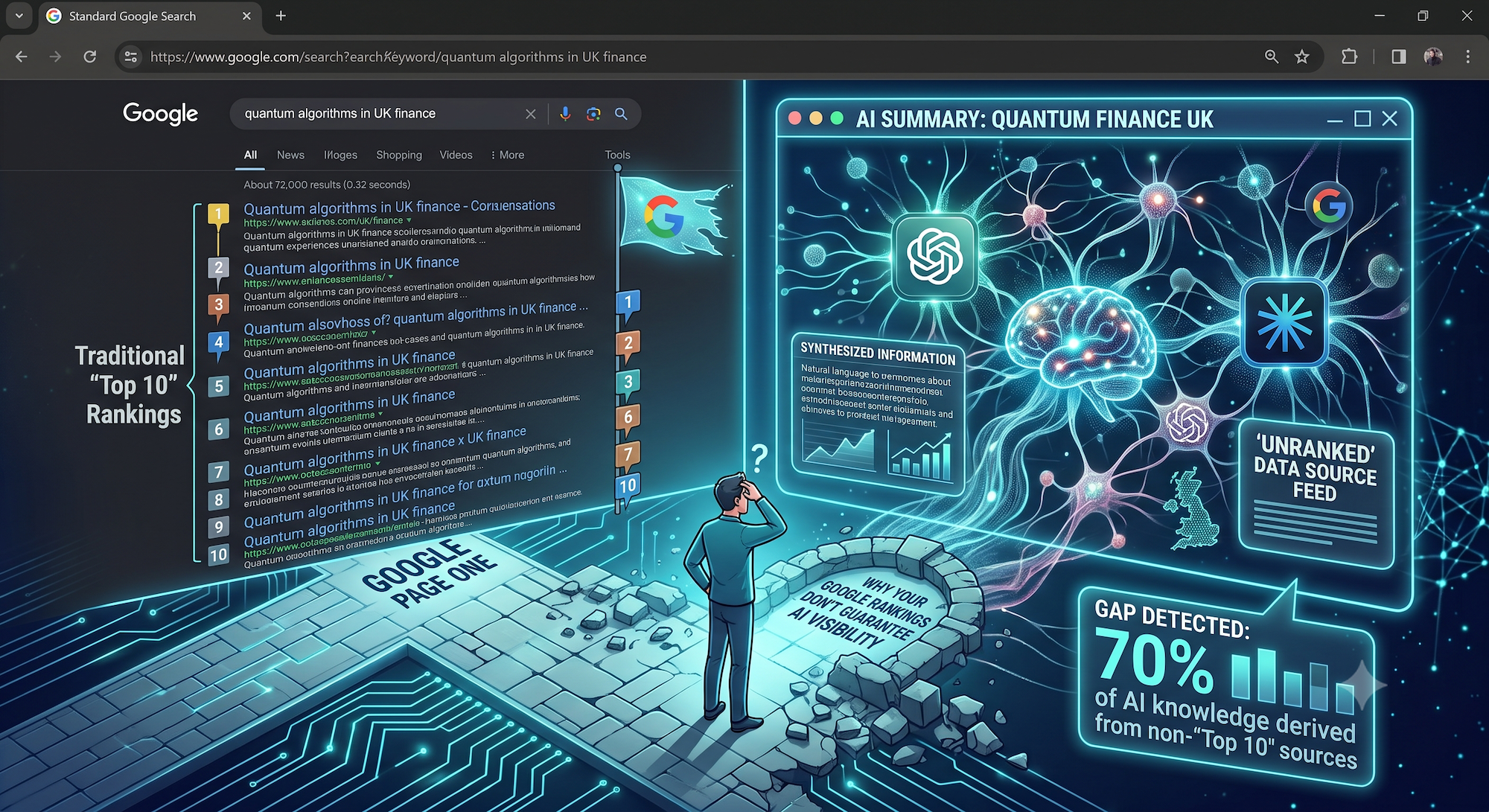

A False Sense of Security
For the longest time, sitting pretty on page one of Google was the absolute holy grail. Businesses poured unimaginable amounts of money into content, chased backlinks like lunatics, and obsessed over technical tweaks just to claim that top spot. If you were ranking number one, you felt completely untouchable. You assumed everybody in the world could see you.
But things have moved on, and that assumption is, frankly, dangerous. We are talking to a staggering number of UK businesses right now who absolutely dominate traditional Google results, yet they vanish completely when someone asks ChatGPT or Perplexity for a recommendation. Ranking on Google simply does not guarantee you'll show up in AI search. If you want a deeper dive into this madness, our What Is AI SEO guide breaks it down in plain English.
Why Good Rankings Don't Equal AI Mentions
To see why this massive disconnect happens, you need to look at what Google cares about versus what AI models actually want.
Google's classic algorithm loves backlinks, domain age, and painfully long-form content. A decade-old website with thousands of links can still rank at the top, even if the writing is terrible, the layout is a complete disaster, and the actual answers are buried under a mountain of corporate waffle.
AI systems do not work like that. They are essentially massive reading comprehension engines. They don't just count your backlinks; they actually try to understand your text. If an AI scans your high-ranking page and can't find a straight answer to a user's question, it won't hesitate to skip you entirely and cite a smaller competitor who actually made their answers obvious.
Here's What This Looks Like in the Real World
Let's say there's a prestigious corporate law firm in Manchester. They rank number one on Google for "corporate solicitor Manchester" because they've spent years building links and publishing dense, 3,000-word articles on legal precedents that nobody actually reads.
Then, a local business owner opens ChatGPT and asks: "Can you recommend a corporate solicitor in Manchester that works with tech startups and does fixed-fee initial consultations?"
The AI goes to work. It checks the big firm's site, hits an impenetrable wall of text about the firm's rich history, and gives up because it can't find anything specific about startups or pricing. Next, it checks a smaller, newer firm. This site has clean headings, an FAQ section using proper schema markup, and a dedicated page explaining their fixed fees for tech startups.
ChatGPT recommends the smaller firm. The big player loses the lead, completely and utterly unaware it even happened.
Why Are You Getting Left Out?
If you're ranking well but AI is ignoring you, it usually comes down to a few very common mistakes:
1. You're Using Too Much Jargon
A staggering number of businesses write to impress their peers instead of just explaining what they actually do. If your site is packed with abstract corporate buzzwords, the AI isn't going to risk guessing what you sell. It'll just move on.
2. Your Content is a Maze
If your answers are hidden in the middle of massive paragraphs without any clear headings, AI systems will struggle to pull them out. They want direct questions followed by direct answers. It's not rocket science.
3. You Aren't Using Schema
If you don't have structured data (schema markup) on your site, you're forcing the AI to figure everything out on its own. Schema acts like a label maker for your code, telling the AI exactly what everything means.
Fixing the Disconnect
Look, if you already have great Google rankings, you're actually in a brilliant starting position. You've got the authority and the technical foundation. Now, you just need to bridge the gap by focusing on clarity, structure, and making sure the AI knows exactly who you are.
Just don't make the catastrophic mistake of thinking your current Google rankings will protect you forever. The way your customers search is fundamentally changing, and your website needs to start speaking the language of the machines that are answering their questions. This is why combining traditional SEO with AI SEO is so critical.
Find Out Where You Currently Stand
Our free AI SEO audit shows you exactly how visible your business is across ChatGPT, Gemini, Perplexity, Grok and Google AI Overviews today.
Get Your Free AI SEO Audit